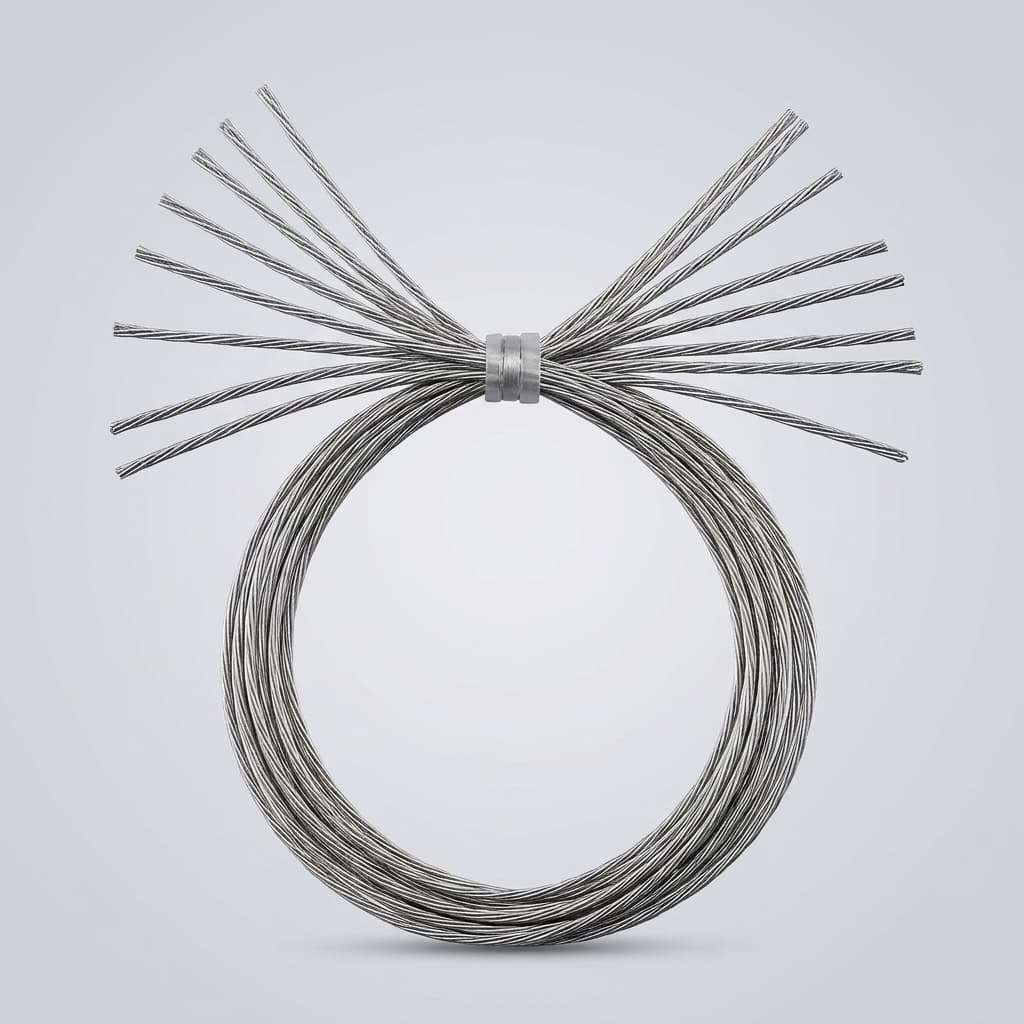
Nitinol vs. Stainless Steel 304V in Catheter Braiding: An OEM Sourcing and Cost-Benefit Guide
Compare Nitinol vs stainless steel 304V catheter braid wire for OEM sourcing, cost, kink risk, lead time, testing, and RFQ decisions. Request DFM input.
When specifying catheter braid wire for a new braided catheter shaft, the choice of reinforcement material is one of the most critical decisions an engineering team will make. The two dominant options—Stainless Steel 304V and Nitinol—are widely used across cardiovascular, neurovascular, and electrophysiology (EP) device programs.
For buyers and procurement teams, however, this engineering choice translates directly into supply chain reality: cost premiums, raw material lead times, and yield rate fluctuations. Understanding exactly why and when to specify one over the other is crucial to avoid over-engineering your device while still hitting clinical performance targets. Choosing the wrong braid material can inflate braid-related BOM and NPI scrap budgets, while choosing a substandard material can create kink, wire breakage, or lumen-patency risks that are much more expensive to correct after design freeze.
This comprehensive guide will walk you through the metallurgical differences, procurement realities, application boundaries, quality inspection criteria, and advanced testing methodologies for both Stainless Steel 304V and Nitinol catheter braiding wires. By the end of this article, you will have a complete framework for making an informed, data-driven sourcing decision for your next catheter program.
Scope note, published July 18, 2026: This guide is written for global OEM catheter shaft sourcing, early DFM, and supplier RFQ discussions. It does not replace device-specific verification, clinical risk analysis, biocompatibility review, or regulatory submissions. Treat the cost and lead-time ranges as planning assumptions to validate with current mill quotes, wire diameter, carrier count, braid angle, annual volume, and supplier CoA data.
1. The Anatomy of a Braided Catheter Shaft
Before diving into the metallurgical specifics of the reinforcement wire, it is essential to understand how the wire interacts with the rest of the catheter. A standard braided catheter shaft is a composite structure typically consisting of three primary layers:
- The Inner Liner (Substrate): Usually made of PTFE (Polytetrafluoroethylene), this ultra-lubricious inner layer ensures that guidewires, stents, or therapeutic agents can pass through the catheter lumen with minimal friction.
- The Reinforcement Layer (The Braid): Sitting directly on top of the PTFE liner, this is a woven matrix of fine wire (either Stainless Steel 304V, Nitinol, or occasionally high-strength polymers like Kevlar or Vectran). The braid gives the catheter its burst strength, column strength (pushability), torque transmission, and kink resistance.
- The Outer Jacket: An extruded layer of thermoplastic elastomer (typically Pebax®, Nylon, or Polyurethane) that is reflowed over the braid. The polymer melts through the interstices of the braid mesh and bonds directly to the etched PTFE liner, locking the entire structure together.
The chosen braid material dictates how the catheter behaves dynamically inside the vascular system, while the outer jacket determines the flexibility profile (usually varying from a stiff proximal shaft to a soft distal tip).
2. The Engineering Difference: Superelasticity vs. Tensile Strength
The fundamental difference between Stainless Steel 304V and Nitinol lies in how they respond to stress, particularly in the tortuous pathways of the human vascular system.
Stainless Steel 304V: The High-Tensile Workhorse
Stainless Steel 304V provides exceptional tensile strength, stiffness, and column strength. When woven into a catheter braid, it delivers excellent 1:1 torque response and pushability. It is the industry workhorse for guiding catheters, delivery sheaths, and diagnostic catheters that must traverse relatively straight paths (such as the femoral artery up to the aortic arch) to deliver bulky devices like structural heart valves or large stent grafts.
However, stainless steel relies entirely on elastic deformation. If it is bent past its yield point—which is relatively low in terms of strain percentage—it will plastically deform. In a clinical setting, this manifests as a permanent kink in the catheter shaft. A kinked catheter can trap a guidewire, block contrast media injection, or make it impossible to advance the therapeutic device, often requiring the physician to remove and replace the catheter entirely.
Nitinol (Nickel-Titanium): The Superelastic Standard
Nitinol (an acronym for Nickel Titanium Naval Ordnance Laboratory) is defined by its superelasticity and shape memory properties. Unlike stainless steel, Nitinol can undergo massive strain (often up to 8%) and fully recover its original shape when the stress is removed. This recovery happens through a reversible, stress-induced martensitic phase transformation at the atomic level, rather than the standard stretching of metallic bonds.
This unique property makes Nitinol practically mandatory for microcatheters navigating the highly tortuous anatomy of the brain (neurovascular applications) or for peripheral applications with severe calcification. A Nitinol-braided catheter can be tied into a literal knot, released, and it will spring back to a perfectly round lumen without any permanent deformation.
3. Why the "V" in 304V Matters
It is a common misconception among novice buyers that 304V is just a marketing term or a slightly different temper of standard 304 stainless steel. In reality, the "V" stands for Vacuum Arc Remelted (VAR).
While governed by the general ASTM A313 standard for spring wire, medical-grade 304V undergoes this secondary VAR process. This involves melting the alloy in a vacuum environment using an electric arc, which systematically removes microscopic non-metallic inclusions, dissolved gases, voids, and tramp elements (impurities) that are acceptable in commercial-grade steel but disastrous in medical devices.
For a catheter braid wire that might be drawn down to a thickness of 0.001" (1 mil, thinner than a human hair), a single microscopic impurity can act as a stress concentrator. During the high-speed braiding process—where up to 32 or 64 bobbins are whipping around a core mandrel under immense dynamic tension—these impurities cause the wire to snap instantly. A single broken wire (known as a "birdcage" or a "loose end") ruins the entire catheter segment, leading to scrapped lots and delayed production schedules.
Procurement Rule of Thumb: Never accept standard 304 stainless steel for catheter braiding. Always ensure your OEM is specifying true 304V to guarantee fatigue resistance, maximize tensile strength, and limit scrap rates during manufacturing.
4. Applicability Boundaries: When to Use Which
Deciding between these materials should never be arbitrary. It requires cross-functional alignment between R&D, clinical affairs, and supply chain.
When to Specify Stainless Steel 304V
- Large Bore Sheaths & Guiding Catheters: If your device requires high pushability and column strength to cross tight stenoses in relatively straight vessels.
- Cost-Sensitive High-Volume Disposables: When the unit economics of the device cannot absorb a premium material cost, such as in high-volume diagnostic catheters.
- Torque-Critical Devices: 304V transmits rotational force from the proximal hub to the distal tip more efficiently than Nitinol, which tends to "store" torque before suddenly whipping. If 1:1 torque is required, 304V is superior.
- Complex Joining: If your distal tip assembly requires reliable laser welding or soldering to other stainless steel components.
When to Specify Nitinol
- Neurovascular & Coronary Microcatheters: Any device navigating the Circle of Willis or tortuous coronary arteries where a kink is a critical failure.
- High-Flexion Implants: If the catheter itself is a long-term implant subject to cyclic loading from body movement.
- Steerable & Deflectable Catheters: Devices that need to take a sharp pre-set shape, straighten out inside a guiding sheath, and then deploy back into that shape (e.g., EP mapping catheters).
- Crush Resistance: When the catheter must resist severe radial compression while maintaining lumen patency.
Hybrid Solutions
Some advanced OEMs offer hybrid braiding, utilizing a combination of both materials (e.g., 8 carriers of Nitinol and 8 carriers of 304V). This approach can yield a catheter that possesses the kink resistance of Nitinol with the pushability and cost-efficiency of stainless steel.
5. Material Properties & Sourcing Comparison Matrix
To aid in the engineering and procurement decision process, the following table breaks down the critical differences between the two materials across multiple dimensions.
| Property / Metric | Stainless Steel 304V (VAR) | Nitinol (NiTi) | Sourcing / Engineering Impact |
|---|---|---|---|
| Relevant Standard | ASTM A313 / ASTM A313M | ASTM F2063 | Ensures medical-grade purity and baseline mechanical testing limits. |
| Primary Advantage | High stiffness, 1:1 torque transmission, cost-effective. | Extreme flexibility, superelasticity, absolute kink resistance. | SS 304V is ideal for pushability; Nitinol is ideal for complex navigation. |
| Kink Recovery | Poor. Once yielded, the shaft is permanently deformed. | Excellent. Can withstand up to 8% strain and recover fully. | Nitinol drastically lowers the risk of device failure mid-procedure. |
| Material Cost | Baseline (Standard Benchmark) | High (Approx. 3x to 5x higher than 304V) | Over-specifying Nitinol drastically increases the BOM cost of the device. |
| Lead Times (Raw Wire) | Short to Moderate (4-8 weeks) | Moderate to Long (12-20+ weeks) | Nitinol sourcing requires longer forecasting and higher safety stock levels. |
| Radiopacity | Moderate | Low | Nitinol often requires heavier use of Platinum-Iridium (Pt-Ir) marker bands. |
| Braiding Tension Sensitivity | Forgiving. Easy to process on standard equipment. | Highly sensitive. Requires precise, electronically controlled tensioners. | Nitinol braiding requires advanced OEM equipment capabilities and higher labor skill. |
| Joining & Welding | Excellent. Easily laser welded or soldered. | Poor. Prone to brittle intermetallics; usually requires mechanical crimping. | Distal tip assembly and hub bonding are more complex and costly with Nitinol. |
6. Surface Finishes: Oxide Layers and Adhesion
Another critical dimension often overlooked during sourcing is the surface finish of the wire.
For Stainless Steel 304V, the wire is typically supplied in a bright, cold-drawn finish. This smooth surface provides excellent consistency, but it can sometimes present challenges for polymer adhesion during the jacket reflow process. Adhesion promoters or plasma etching may be required for optimal bonding.
Nitinol, however, forms a robust titanium oxide layer during its thermal processing. Buyers must specify the oxide finish:
- Light Oxide (Amber/Blue): The standard finish, providing a balance of drawability and surface roughness.
- Dark Oxide: A thicker, rougher oxide layer that provides exceptional mechanical interlocking with polymer jackets, greatly reducing the risk of delamination in high-stress applications.
- Oxide-Free (Etched/Electropolished): Used when the wire must be joined via welding or when maximum fatigue life is paramount, as the oxide layer can occasionally initiate micro-cracks. Oxide-free wire is significantly more expensive.
7. Failure Risks and Mitigation
Every material has its weaknesses. Understanding the failure modes of your chosen wire is essential for proper risk mitigation and regulatory submissions (like FDA 510(k) or MDR).
Stainless Steel 304V Failure Modes
- Kinking Under Torsion: If a physician torques a 304V braided catheter excessively while the distal end is lodged tightly in a calcified lesion, the braid can wind up and permanently buckle. Mitigation: Incorporate a robust inner PTFE liner and a high-durometer Pebax outer jacket to constrain the braid, and clearly specify maximum torque limits in the Instructions for Use (IFU).
- Wire Breakage During Manufacturing: Caused by poor quality wire (non-VAR) or improper braider carrier tension. Mitigation: Demand ASTM A313 compliance, rigorous incoming inspection, and a valid Certificate of Analysis (CoA).
Nitinol Failure Modes
- "Whip" Effect: Because Nitinol is superelastic, it can store torsional energy like a wound-up spring. When it finally overcomes the friction holding it back, the distal tip can whip uncontrollably, potentially damaging vessel walls. Mitigation: Optimize the braid angle (PIC count, or Picks Per Inch) and consider a hybrid braid architecture.
- Fatigue Fracture from Inclusions: Despite superelasticity, Nitinol is highly susceptible to fatigue failure if the material contains oxide or carbide inclusions. Mitigation: Demand ultra-pure melt Nitinol per ASTM F2063 with inclusion limits strictly monitored, and conduct aggressive accelerated lifecycle testing.
8. Catheter Testing Protocols: Verifying Braid Performance
To validate your material choice, your R&D and QA teams must execute a series of rigorous mechanical tests.
- Kink Radius Testing: The catheter is bent around progressively smaller mandrels until it buckles or the lumen collapses. Nitinol-braided catheters will consistently achieve tighter kink radii than 304V equivalents.
- Trackability and Pushability Testing: Utilizing anatomical models (like an arch model or coronary tree), the catheter is advanced using a load cell. 304V typically registers higher transmission of force to the distal tip (better pushability).
- Burst Pressure Testing: Fluid is pumped into the catheter until the wall ruptures. The braid material, wire diameter, and PIC count directly determine the burst threshold.
- Three-Point Bend Flexural Testing: Measures the stiffness profile of the shaft to ensure a smooth transition from the stiff proximal hub to the soft distal tip.
9. OEM Evaluation and Sourcing Checklist
Before freezing the design on your reinforcement layer and issuing a Purchase Order (PO), use this checklist to align engineering intent with procurement reality. This checklist is critical for ensuring your RFQ covers all necessary supplier communication fields.
Buyer, QA, & Engineering Procurement Checklist
- Clinical Pathway Assessment: Are we navigating tortuous anatomy? (Femoral/straight -> 304V. Neurovascular/tortuous -> Nitinol).
- Hybrid Braid Feasibility: Have we requested a hybrid braid analysis (e.g., alternating Nitinol and 304V carriers)? This offers a middle-ground solution balancing cost and flexibility.
- Material Certification (304V): Did we explicitly request the 304V Vacuum Arc Remelted (VAR) CoA? Do not accept standard commercial 304.
- Material Certification (Nitinol): Is the Nitinol wire certified to ASTM F2063-18 or newer? Are inclusion limits specified?
- Surface Finish Specification: Have we explicitly defined the required oxide level for Nitinol (Dark, Light, or Oxide-Free) to ensure polymer adhesion?
- Lead Time Alignment: Are our production forecasts aligned with Nitinol's raw material lead times (often 16 to 24 weeks)? Do we need to establish a Vendor Managed Inventory (VMI) agreement?
- Equipment Verification: Does the OEM have modern electronic tension control braiders (e.g., Steeger or equivalent) required for processing sensitive Nitinol wire without inducing strain?
- Secondary Operations: Is thermal shape setting required for the distal tip? If so, does the OEM have the necessary salt baths, fluidized beds, or high-temperature furnaces in-house?
- Scrap Rate Allowances: Has the OEM provided an estimated scrap rate for the Nitinol design? (Nitinol typically incurs a higher scrap percentage during early process validation and NPI phases).
- Biocompatibility Data: Has the supplier provided the necessary biological evaluation reports (ISO 10993) for the specific alloy batches?
- Radiopacity Strategy: If using Nitinol, what is our plan for fluoroscopic visibility? (e.g., adding a Pt-Ir co-braid, swaged marker bands, or radiopaque polymer fillers like Barium Sulfate).
10. Frequently Asked Questions (FAQ) from Catheter Buyers
Can we weld Nitinol to Stainless Steel?
Welding Nitinol directly to stainless steel is notoriously difficult. The process forms brittle intermetallic compounds (such as TiFe) in the weld pool, which fracture easily under minimal cyclic strain. While some highly specialized laser welding techniques using intermediate filler metals (like Tantalum or Nickel) exist, most OEMs rely on mechanical crimping, swaging, or polymer reflow encapsulation to join these dissimilar metals within a catheter shaft.
Does Nitinol wire require a completely different braiding machine?
No, Nitinol can technically be braided on the same Steeger or Wardwell rotary braiders used for 304V. However, Nitinol is vastly more sensitive to dynamic tension variations. Your OEM must have modern braiders equipped with precise, electronically controlled let-off tensioners on their carriers. Older mechanical friction-brake braiders will cause uneven pick counts, "birdcaging," and unacceptable scrap rates when running Nitinol.
Why is Nitinol so much more expensive than 304V?
Nitinol's high cost stems from the extreme difficulty of its manufacturing process. It requires primary vacuum induction melting (VIM) followed by vacuum arc remelting (VAR) to prevent titanium oxidation. The nickel-titanium atomic ratio must be rigorously controlled—even a 0.1% shift drastically changes the alloy's transition temperature (Af). Furthermore, drawing Nitinol down to ultra-fine wire is incredibly harsh on diamond drawing dies due to its rapid work-hardening nature and abrasive surface oxides, requiring frequent die replacement and annealing cycles.
How do I verify that I am actually receiving VAR 304V and not standard 304?
As a buyer, you must demand a Certificate of Conformity (CoC) and a Certificate of Analysis (CoA) from the primary wire drawing mill (e.g., Fort Wayne Metals, Ulbrich, or equivalent), not just a general compliance statement from the braiding OEM. The CoA will explicitly state the melting method (VAR) and verify compliance with ASTM A313.
Is it possible to use a flat wire (ribbon) instead of round wire?
Yes. Both 304V and Nitinol can be rolled into flat ribbons (e.g., 0.001" x 0.003"). Flat wire braiding provides a lower profile (thinner catheter wall) and slightly higher burst strength than round wire, but it is more difficult to braid uniformly, tends to flip during processing, and significantly increases raw material costs.
What is the impact of Nitinol on overall product yield rates?
During the New Product Introduction (NPI) phase, Nitinol designs typically suffer lower yield rates compared to 304V due to tension sensitivity and handling challenges. A mature 304V process might hit 95%+ yield, whereas a complex Nitinol microcatheter might stabilize around 85-90%. Buyers should factor these yield assumptions into their unit cost models.
11. Navigating the Sourcing Decision
Ultimately, the choice between Nitinol and Stainless Steel 304V is a balancing act between clinical necessity, manufacturability, and commercial viability.
Engineering teams will naturally lean toward Nitinol for its "forgiving" nature, incredible flexibility, and impressive handling characteristics. Procurement and supply chain teams will favor 304V for its cost stability, robust supply chain, shorter lead times, and highly predictable manufacturing yields.
The best medical device OEMs bridge this gap by offering iterative, rapid prototyping. By manufacturing and testing a 304V braid against a Nitinol braid—and perhaps a hybrid architecture of the two—you can generate the empirical data needed to justify the final BOM to both your clinical advisory board and your CFO. A well-designed catheter does exactly what the physician needs it to do, without paying a premium for material properties that the anatomy doesn't require.
12. Sources and References
For further reading on the exact metallurgical specifications, regulatory considerations, and mechanical testing standards for these materials, please consult the following primary sources:
- ASTM F2063 - 18: Standard Specification for Wrought Nickel-Titanium Shape Memory Alloys for Medical Devices and Surgical Implants - Defines the chemical composition and mechanical properties for medical-grade Nitinol.
- ASTM A313 / A313M - 18(2025): Standard Specification for Stainless Steel Spring Wire - The baseline standard for stainless steel spring wire, prior to program-specific VAR and medical-device purchasing controls.
- FDA Guidance: Technical Considerations for Non-Clinical Assessment of Medical Devices Containing Nitinol - Essential reading for regulatory submissions involving superelastic alloys.
Need Help Choosing the Right Braid Architecture?
Whether you need the pushability of VAR 304V, the extreme kink resistance of Nitinol, or a complex hybrid solution, our engineering team can provide Design for Manufacturability (DFM) feedback and rapid prototyping.
Discuss Your Catheter Specs
Author

Categories
More Posts
FDA Early Alert: Abiomed/Oscor Large-Bore Sheath Leakage and Hub Bonding Risks
The June 2026 FDA Early Alert regarding Abiomed and Oscor 14Fr/23Fr introducer sheaths reveals critical hub bonding and splittable score line vulnerabilities in large-bore catheter manufacturing.

Catheter Marker Band Assembly: Swaging vs. Bonding for Radiopacity
A practical engineering guide to integrating radiopaque marker bands into reinforced catheter shafts. We compare swaging and thermal bonding techniques, dimensional tolerances, and inspection criteria.
FDA Class I Recall (July 2026): Mitigating Distal Tip Detachment in Delivery Catheters
The recent Class I recall of a major delivery catheter system over distal tip detachment highlights critical risks in inner shaft assembly and transition zone bonding. Learn how buyers and OEM engineers can audit suppliers to prevent this manufacturing defect.