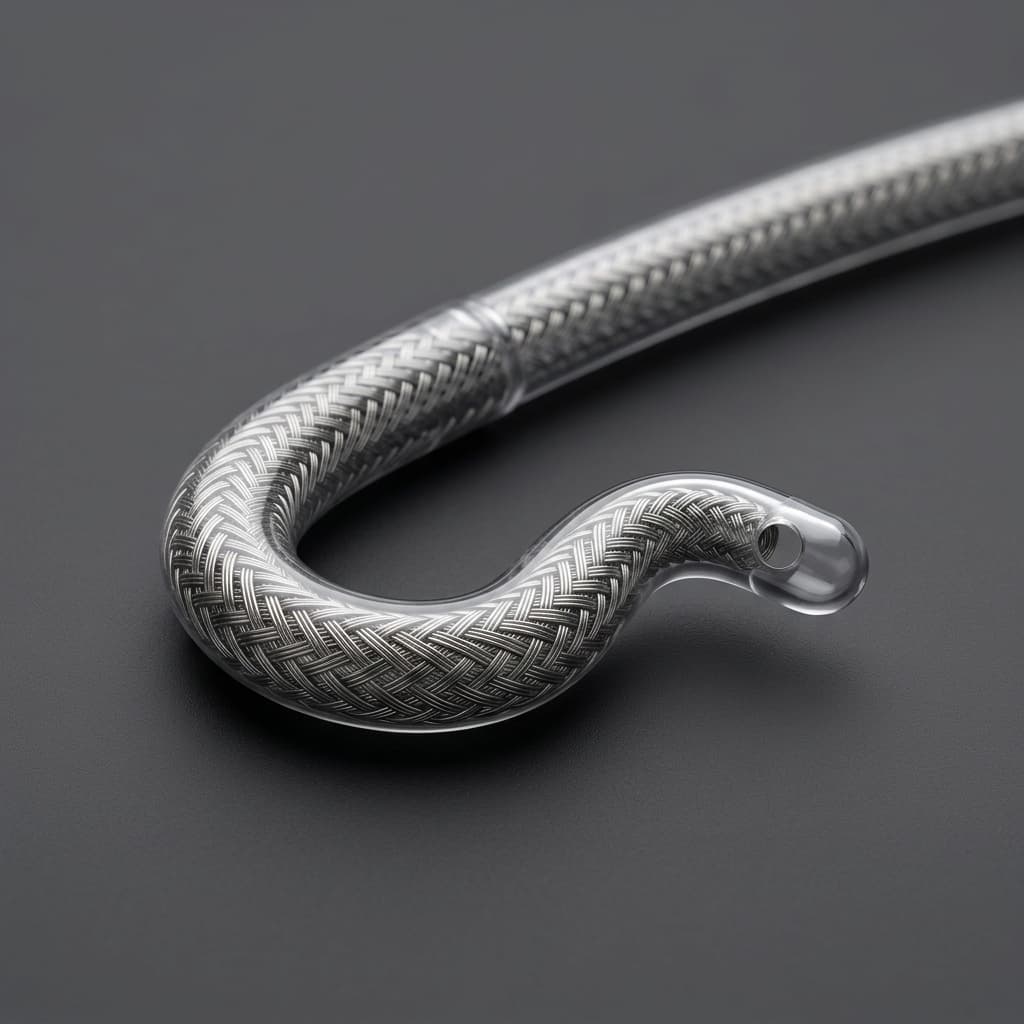
Braided vs. Coil Reinforced Catheters: Choosing the Right Shaft Architecture
A deep dive into when to specify a braided catheter shaft versus a coil reinforced catheter for neurovascular, cardiovascular, and structural heart applications. Includes material data and PPI calculations.
Choosing the right shaft reinforcement often makes or breaks a new delivery system or microcatheter. The reinforcement layer alone dictates pushability, trackability, kink resistance, and torque response. Get this wrong, and you'll likely face expensive redesign loops after pilot testing.
[!TIP] Key Takeaways for Buyers
- Braids excel at torque transmission (1:1 response) and pushability.
- Coils dominate in extreme flexibility and kink resistance in tortuous anatomy.
- Flat wire coils (
0.0005" x 0.002") are the gold standard for maximizing lumen ID while minimizing wall thickness. - Hybrid Shafts combine proximal braids with distal coils to achieve the best of both worlds in structural heart and neurovascular delivery systems.
The two dominant architectures are braided reinforcement and coil reinforcement. In many advanced applications, a hybrid approach combining both is utilized. This guide breaks down the core differences, exact dimension limitations, and material choices to help you specify the right solution for your OEM RFQ.
1. Braided Catheter Shafts
Braided catheters utilize wires (typically 304V stainless steel, Nitinol, or high-tensile polymers) interwoven in a specific pattern over a mandrel and inner liner.
The Physics of Braid Patterns
The geometry of the braid fundamentally determines performance:
- 1-over-1-under-1 (Diamond Braid): Tighter, denser. Best for burst pressure and rigid pushability.
- 2-over-2-under-2 (Herringbone): More flexible. Ideal when moderate torque and higher trackability are required.
PPI (Picks Per Inch) & Braid Angle
The PPI controls the braid angle relative to the longitudinal axis:
- Low PPI (e.g., 30-50 PPI): Creates a low braid angle (< 45°). Delivers superior axial pushability and column strength, but poorer flexibility.
- High PPI (e.g., 90-140 PPI): Creates a high braid angle (> 45°). Delivers excellent flexibility, radial hoop strength, and burst pressure, but reduced pushability.
Key Advantages:
- Exceptional Torque Transmission: The interlocking wire structure allows for 1:1 torque response, making it ideal for navigating tortuous anatomy.
- High Pushability: The braid pattern transfers axial forces efficiently without buckling.
Common Applications: Electrophysiology (EP) mapping catheters, diagnostic angiography catheters, and cardiovascular guiding catheters.
2. Coil Reinforced Catheters
Coil reinforcement involves winding a single (unifilar) or multiple (multifilar) wire helically around the inner liner.
Flat Wire vs. Round Wire
- Round Wire: Cost-effective, standard flexibility. Typical diameters range from
0.001" to 0.005". - Flat Wire: Achieves the lowest possible wall thickness while maximizing inner diameter (ID). Typical flat wire dimensions are
0.0005" x 0.002". Flat wire coils drastically increase hoop strength without the OD penalty of a braid.
Pitch and Gap Spacing
The Pitch (distance between the center of one wire wrap to the next) dictates flexibility:
- Closed Pitch (Zero Gap): Maximum kink resistance and hoop strength, highly flexible, but zero column strength.
- Open Pitch (Gapped): Allows the outer jacket to bond deeply with the inner liner between the coils, preventing delamination while maintaining kink resistance.
Key Advantages:
- Maximum Kink Resistance: Coils provide superior hoop strength, ensuring the lumen remains patent even when bent at severe acute angles.
- Extreme Flexibility: Without interlocking wires, coil reinforced shafts can navigate the most tortuous neurovascular pathways (e.g., M1/M2 segments in the brain).
Common Applications: Neurovascular microcatheters, aspiration catheters, and distal segments of delivery systems.
3. The Architecture Decision Matrix
Use the following reference matrix to align your engineering priorities before contacting an OEM.
| Feature Priority | Braided Shaft | Coil Reinforced | Hybrid (Braid + Coil) |
|---|---|---|---|
| Torque Response (1:1) | ⭐⭐⭐⭐⭐ | ⭐ | ⭐⭐⭐⭐ |
| Pushability (Column Strength) | ⭐⭐⭐⭐⭐ | ⭐⭐ | ⭐⭐⭐⭐ |
| Kink Resistance | ⭐⭐⭐ | ⭐⭐⭐⭐⭐ | ⭐⭐⭐⭐⭐ |
| Ultra-Thin Wall Profile | ⭐⭐ (Overlapping wires) | ⭐⭐⭐⭐⭐ (Flat wire) | ⭐⭐⭐ |
| Flexibility / Trackability | ⭐⭐⭐ | ⭐⭐⭐⭐⭐ | ⭐⭐⭐⭐ |
| Burst Pressure / Injectability | ⭐⭐⭐⭐⭐ | ⭐⭐ | ⭐⭐⭐ |
4. Hybrid Shafts: The Best of Both Worlds
For complex procedures like structural heart transcatheter aortic valve replacement (TAVR) delivery or advanced neurovascular interventions, a single reinforcement type may not suffice.
A Hybrid Shaft often begins with a braided proximal section to provide pushability and torque from the user's hand, and transitions via continuous winding or a butt-weld to a coil-reinforced distal section for maximum flexibility and kink resistance in tortuous vessels.
5. Summary Checklist for OEM Buyers
Before submitting an RFQ to your catheter manufacturing partner, ensure you have documented the following:
- Reinforcement Material: 304V SS, 316L SS, Nitinol, or Tungsten?
- Wire Geometry: Round (specify dia.) or Flat (specify thickness x width)?
- Density Requirements: Target PPI (for braids) or Pitch (for coils)?
- Wall Constraints: What is the strict maximum OD and minimum ID?
Need Prototypes?
Whether you need a simple flat-wire coil extrusion or a multi-zone hybrid braided shaft with an etched PTFE liner, our manufacturing team can execute it. Send your prints to [email protected] to get an honest DFM review and a pilot quote.
Author

Categories
More Posts
EtO Sterilization EPA Rules (2026): Impact on Catheter Polymer Selection and Sourcing
Use this 2026 EtO sterilization EPA rules guide to compare catheter polymer risks, radiation trade-offs, sourcing checks, and OEM review steps.

Variable Pitch vs. Multi-Segment Braiding: Optimizing Catheter Flexibility and Cost
Compare variable pitch braiding vs multi-segment catheter shafts for flexibility, kink risk, yield, cost, and OEM RFQ decisions. Request a DFM review.
Buyer Guide: How to RFQ Braided & Coil Reinforced Catheter Shafts
A practical engineering and sourcing checklist for medical device teams evaluating catheter shaft OEM partners. Includes specific CTQ tolerance guides and material selection matrices.