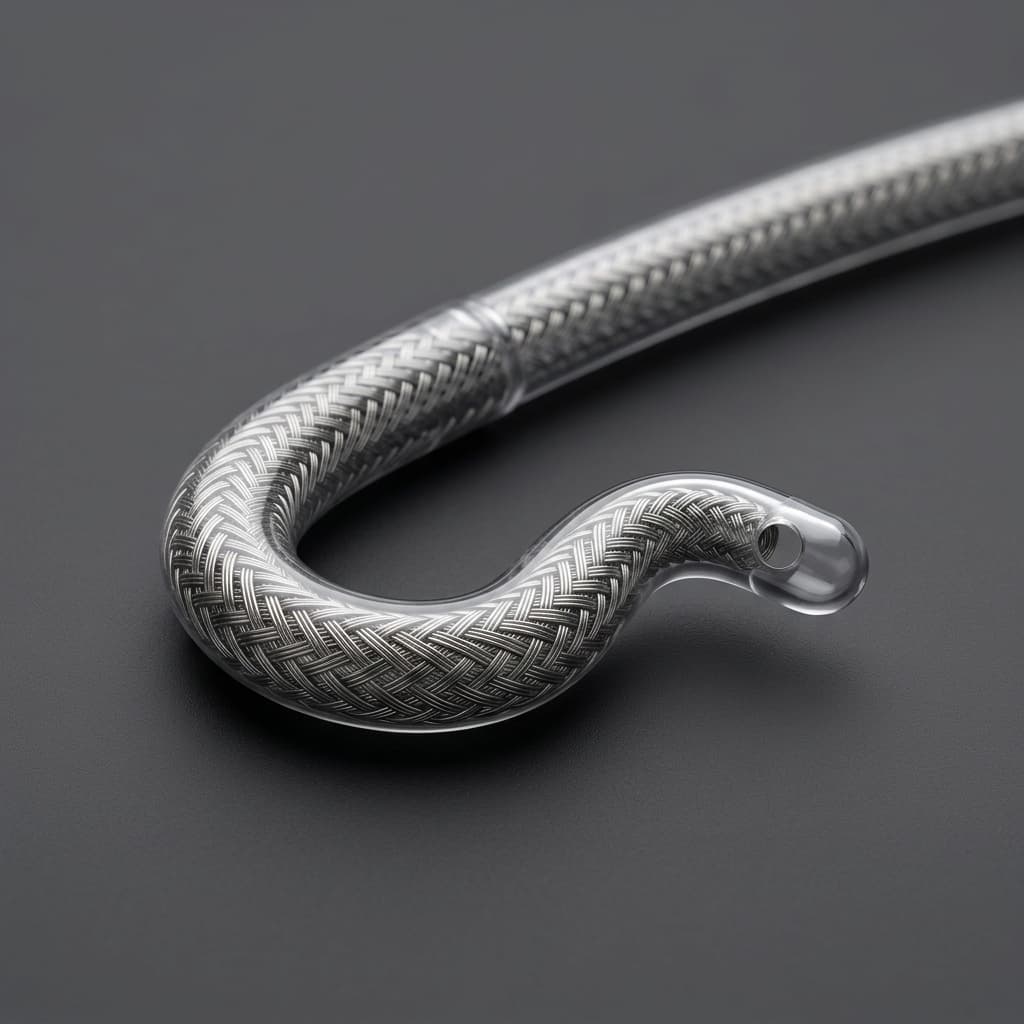
FDA Class I Recall (July 2026): Mitigating Distal Tip Detachment in Delivery Catheters
The recent Class I recall of a major delivery catheter system over distal tip detachment highlights critical risks in inner shaft assembly and transition zone bonding. Learn how buyers and OEM engineers can audit suppliers to prevent this manufacturing defect.
[!CAUTION] Decision-Level Conclusion: Executive Summary for Sourcing & Engineering A July 2026 FDA Class I recall of the Medtronic Harmony Delivery Catheter System revealed that manufacturing defects in the inner shaft assemblies can lead to the detachment of the distal tip during implantation. This is not a core implant design flaw, but a pure delivery system manufacturing issue at the transition zone. Procurement teams and specifiers must immediately audit their OEM partners for Automated Pull Testing (Tensile Testing) protocols and laser-welding/reflow tolerances at braided-to-non-braided joint transitions.
What Changed: The July 2026 Recall
The FDA has classified the recall of the Medtronic Harmony Delivery Catheter System as Class I (the most serious type of recall), following reports that the catheter's distal tip (nose cone) could detach during implantation.
Timeline of Escalation
| Date | Event | Regulatory Action |
|---|---|---|
| May 28, 2026 | Initial customer notification from Medtronic | Customers instructed to quarantine and return affected lots |
| June 2026 | Field safety corrective action (FSCA) ongoing | Investigation traces issue to inner shaft assemblies |
| July 2026 | FDA classification issued | Designated as Class I Recall (highest severity) |
This is a critical signal for the contract manufacturing industry because the root cause was traced directly to manufacturing variations in the inner shaft assembly, rather than an inherent flaw in the implanted valve itself. For OEM buyers, this reinforces that even proven delivery system designs are vulnerable to catastrophic failure if shaft bonding and transition zone joint strengths are not tightly controlled on the factory floor.
Distal Tip Joint Manufacturing Variations
| Factor | Legacy Standard Practice | Recommended Practice (Post-Recall) |
|---|---|---|
| Joint Inspection | Manual visual inspection of reflow/bond zone | 100% Automated Vision AI inspection for voids |
| Tensile Testing | Sample batch testing (AQL 1.0) | Increased sampling rate with Automated Pull Testing |
| Process Control | Operator-dependent thermal reflow | Programmable laser welding / precision thermal profiling |
| Tolerance | +/- 0.005" on bond length | +/- 0.001" on critical transition zones |
| Traceability | Lot-level tracking | Individual shaft joint parameter logging |
Why it Matters: The Transition Zone Vulnerability
Catheter shafts often require a braided or coil-reinforced proximal and mid-section for pushability, transitioning to an unreinforced, highly flexible polymer distal tip to avoid trauma to vasculature. The joint between these two distinct material profiles is the Achilles' heel of the delivery system.
When the inner shaft assembly fails here, the detached tip can embolize or cause severe internal damage. For medical device buyers, partnering with an OEM that lacks rigorous joint strength validation creates unacceptable supply chain and regulatory risks.
Who Should Act Now: Buyer Checklist
Procurement teams, quality assurance directors, and R&D engineers actively sourcing braided or coil-reinforced catheter assemblies should take immediate action.
OEM Evaluation Action Plan
- Request Reflow Data: Ask your manufacturing partner to provide CpK (Process Capability) data for their transition zone bonding or welding processes.
- Review Tensile Protocols: Verify that their pull testing aligns with ISO 10555-1 or your specific product requirements, and ask whether testing is automated or manual.
- Audit Material Transition: Evaluate if the transition from the braided shaft to the unbraided tip can be improved by extending the braid with a lower PPI (Picks Per Inch) rather than an abrupt cutoff.
- Demand 100% Visual Inspection: Ensure the OEM utilizes high-resolution vision systems to detect micro-voids, delamination, or misaligned polymer jackets at the joint.
Risks and Evidence Gaps
While the FDA notice provides a clear mandate, there are specific boundaries and evidence gaps buyers must navigate:
- Unknown Material Specifics: The FDA Class I notice does not disclose the exact polymer blends or adhesive types that failed. Buyers cannot simply ban a specific material based on this recall.
- Process vs. Design: The recall cites a "manufacturing issue," but the boundary between an un-manufacturable design and a poor manufacturing process is often blurred. OEMs may blame the design if tolerances are set impossibly tight.
- Cost vs. Yield: Implementing 100% automated inspection and increased tensile sampling will increase unit costs. Procurement must balance this against the catastrophic cost of a Class I recall.
OEM Joint Inspection Risk Matrix
Procurement should evaluate suppliers against this matrix to determine supply chain vulnerability:
| OEM Joint Process & Inspection | Likelihood of Defect Escape | Clinical Severity if Detached | Risk Mitigation Action |
|---|---|---|---|
| Manual Reflow + AQL Visual | High | Catastrophic (Class I) | Immediate Audit / Redesign |
| Manual Reflow + 100% Visual | Medium | Catastrophic (Class I) | Demand Automated Pull Tests |
| Laser Weld + 100% Vision AI | Low | Catastrophic (Class I) | Acceptable / Monitor |
Comparison of Bonding Methods
| Bonding Method | Mechanical Strength | Process Control | Capital Equipment Cost | Typical Application |
|---|---|---|---|---|
| Thermal Reflow | High | Medium (operator dependent) | Low | Standard cardiovascular catheters |
| Laser Welding | Very High | High (programmable) | High | Neurovascular, highly critical joints |
| Adhesive Bonding | Medium | Low to Medium | Low | Simple, non-load-bearing transitions |
| Overmolding | High | High | Very High | Complex multi-lumen hubs |
| Ultrasonic Welding | Medium-High | Medium | Medium | Rigid polymer connections |
FAQ: Sourcing Delivery Catheters Post-Recall
Q: Should we halt our current delivery catheter development if it uses a similar distal tip joint? A: No. But you should immediately pause and ask your contract manufacturer to present their failure mode and effects analysis (FMEA) specifically focusing on inner shaft tensile failure.
Q: How many units should an OEM test for distal tip detachment? A: It depends on your risk profile, but relying solely on a minimal AQL sampling is no longer sufficient for life-sustaining delivery systems. Discuss moving to continuous automated testing for critical joints.
Q: Does this recall affect the core implantable valve? A: No, this issue is strictly isolated to the delivery catheter's inner shaft assembly manufacturing process.
Architectural Considerations for Engineers
When designing a catheter that will be handed off to an OEM, engineers face a classic trade-off: pursuing maximum distal softness for trackability while maintaining sufficient tensile strength to prevent detachment upon withdrawal or deployment.
Sources
- FDA Recall Notice: Medtronic Recalls Harmony Delivery Catheter System Due to Distal Tip Detachment - Issued July 2026. Details the Class I classification and the specific risk of pulmonary regurgitation and embolism. (Date: July 2026)
- MedTech Dive: Medtronic Harmony Delivery System faces Class I recall - Coverage of the May 28, 2026 customer notification and subsequent regulatory actions. (Date: July 2026)
- ISO 10555-1: Intravascular catheters — Sterile and single-use catheters — Part 1: General requirements (Tensile strength requirements for catheter joints).
Author

Categories
More Posts
Preventing Hydrophilic Coating Delamination: A Sourcing Guide for Catheter OEMs
Hydrophilic coating delamination guide for catheter OEMs: compare bonding methods, FDA risk signals, supplier questions, and RFQ controls before sourcing.

EtO Sterilization EPA Rules (2026): Impact on Catheter Polymer Selection and Sourcing
Use this 2026 EtO sterilization EPA rules guide to compare catheter polymer risks, radiation trade-offs, sourcing checks, and OEM review steps.
Variable Pitch vs. Multi-Segment Braiding: Optimizing Catheter Flexibility and Cost
Compare variable pitch braiding vs multi-segment catheter shafts for flexibility, kink risk, yield, cost, and OEM RFQ decisions. Request a DFM review.