Check nominal layer fit, prepare your RFQ, then compare the evidence a development and manufacturing partner should provide.
Four decisions before you select a CDMO
Prepared by Catheter Braiding OEM (Catheter Braiding OEM). First recorded in this site’s repository October 25, 2026; public release date is unverified. Engineering interpretation reviewed . These recommendations combine the explicit geometry below with public source scopes; they are not supplier audit findings.
1. Resolve the wall budget first
If liner and crossover envelope consume the radial wall, change the dimensions before requesting a build. A positive remainder still needs tolerance review. See the reproducible method.
2. Compare assemblies against requirements
Flat versus round wire is a prototype comparison, not proof of equivalent torque or kink resistance. Define conditions and criteria before testing. [S2]
3. Buy evidence along with parts
Ask for controlled records, test reports and quality responsibilities at each transfer gate. Supplier certification remains unconfirmed until records are reviewed. [S3]
4. Confirm scope before applying a standard
Distinguish catheter requirements from stent bending or film wetting methods. An adapted test needs its own documented rationale. [S1][S4][S5]
Calculation method, units and known limits
The tool uses an ideal circular, single-lumen shaft with one liner and a two-wire crossover. Calculations retain full numerical precision internally; exported decimals are rounded for readability. Input ranges limit this tool, and do not describe manufacturing capability.
Schematic layer order only. Actual crossover height, wire embedding and compression must be measured.
Reproducible nominal geometry; all inch inputs are radial thicknesses except OD and ID.
Quantity
Method
Limitation
OD in mm
OD (Fr) ÷ 3
Use finished-part OD, not an introducer compatibility label.
OD in inches
OD (mm) ÷ 25.4
1 inch = 25.4 mm.
Total radial wall
(OD in inches − ID in inches) ÷ 2
ID must be strictly smaller than OD.
Braid radial envelope
2 × wire thickness (or round-wire diameter)
Simplified crossover assumption; no compression credit.
Remaining jacket space
Radial wall − liner wall − braid envelope
Must be positive; excludes tolerances and extra features.
Screening flags
Jacket < 0.0008 in; flat-wire aspect ratio > 4.5:1
Illustrative internal review flags, not validated acceptance limits.
Known: entered nominal dimensions and the arithmetic above. Unknown: braid angle/coverage, final bond quality, process yield and mechanical performance. PPI and carrier count are RFQ context; the supplier must confirm pick convention and actual braid geometry.
Flat wire, round wire and alternative reinforcement
Use these as engineering comparison questions. No universal percentage improvement, equivalent stiffness or material safety claim is established by this page. Require representative bench evidence for the final assembly. [S2]
A narrower radial envelope can free wall space, but only a dimensioned comparison establishes that advantage for your concept.
Decision matrix: compare options at the same OD, ID, length and acceptance criteria.
Option
Question to resolve
Tradeoff / next evidence
Flat wire
Does specified thickness leave more nominal jacket space?
Width, rollover and orientation need supplier cross-section review.
Round wire
Can the diameter fit while meeting the same device targets?
Compare coupon handling, composite behavior and quoted cost; do not infer equivalence.
Nitinol / stainless / tungsten / PEEK
What grade, finish and behavior does the application require?
Obtain material certificates and assembly-specific test evidence; no MR status inferred.
Coil or braid/coil hybrid
Does the distal function need a different reinforcement approach?
Budget transition overlap and test the joint; compare a separate concept, not an assumed drop-in replacement.
Positive nominal clearance is only the first screen. Ask for a supplier-reviewed tolerance stack before setting drawing acceptance limits. A conservative starting expression is (minimum OD − maximum ID) ÷ 2 − maximum liner − 2 × maximum wire thickness; additional features require their own envelope.
Unverified dimensions and methods must be resolved on the controlled drawing.
Variable
Risk if ignored
Evidence to request
OD and ID tolerances
Nominal clearance can disappear at the dimensional extremes.
Worst-case stack, metrology method and measurement capability.
Wire crossover / embedding
Actual braid height may differ from the ideal envelope.
Sections from representative reflow coupons; document orientation and sampling.
Markers, pull wires, adhesive, coating
Local wall consumption or stiffness changes are absent from this tool.
Feature-specific sections, dimension budget and transition tests.
Concentricity and process variation
One side of the wall can be thinner than the nominal budget.
Section locations, measurement uncertainty, lot data and agreed criteria.
Qualify a CDMO with evidence you can inspect
The practical recommendation is to review records that apply to the proposed site, process and part. The FDA QMSR framework is relevant context; it is not a certificate for this website or a guarantee about any factory. [S3]
Supplier evaluation worksheet; no supplier rating has been assigned.
Decision
Ask for
What remains unproven
Quality system scope
Current certificate, issuing body, scope, site and applicable quality agreement.
A certificate alone does not establish shaft-specific process capability.
Braid / reflow capability
Representative coupons and dimensional data using the intended stack.
A machine list does not prove yield or performance.
Environment and traceability
Relevant environmental records, material traceability and release records.
No cleanroom classification is claimed on this page.
Measurement / process control
Measurement study, sampling rationale and relevant lot data.
Do not treat one generic Cpk value as a universal release rule.
Ownership and continuity
Tooling ownership, recipe access, change notification and transfer terms.
NDA terms alone do not settle background IP or transfer rights.
Separate geometry screening from functional verification
Later steps require supplier and sponsor evidence. This ladder is a workflow illustration, not measured performance data.
ISO 10555-1 provides catheter requirements within its scope; the sponsor should determine applicable editions, clauses and device-specific additions. FDA bench-report guidance supports documented protocols and reports, not predetermined passing values. [S1][S2]
Suggested planning questions, not a complete or mandatory test list.
Concern
Protocol inputs to agree
Result needed for a decision
Tensile joints / shaft
Sample configuration, conditioning, pull setup and acceptance criteria.
Failure load, location, mode and rationale against the requirement.
Pressure / aspiration collapse
Pressure medium, loading, duration, temperature and assembly state.
Measured leakage or collapse behavior; no predicted psi rating from this tool.
Kink / tracking / torque
Anatomical path or fixture, bend conditions, rotation and endpoints.
Repeatable response including lag, recovery and failure observations.
Sterilization / aging
Exact assembly, process exposure, packaging, aging and retest plan.
Validated compatibility and residuals where applicable; no universal material guarantee.
MR evaluation
All assembly components, intended conditions and appropriate assessment plan.
Device-specific evaluation and labeling; material name is insufficient.
Do not substitute ASTM F2606 stent bending for a catheter kink protocol or ASTM D2578 film wetting for PTFE bond qualification without a justified adaptation. [S4][S5]
Stage the development and manufacturing engagement
No fixed duration is implied. The tool starts the remaining gate list at your selected engagement phase.
Scope the quotation around deliverables and acceptance gates.
Stage
Decision before advancing
Schedule and cost dependencies
Prototype / DFM
Do measured sections and dimensions justify the next design revision?
Material availability, mandrel design, tooling and coupon iterations.
Design verification
Does the representative design meet approved requirements?
Protocol agreement, sample count, fixtures and failure resolution.
Pilot qualification
Is the process evidence adequate for the agreed production scope?
Representative lots, measurement capability, controls and documentation.
Commercial transfer
Are ownership, quality and release responsibilities accepted?
Transfer package, supply agreement, capacity and applicable packaging/sterilization work.
Prices, MOQ and delivery dates: not verified. Request written line items for NRE/tooling, samples, inspection, destructive tests, qualification, packaging and recurring units. Compare quotations using the same drawing revision and included services.
Misuse, cost and scenario-fit risks
Risk register for the sourcing discussion; severity and likelihood need project-specific assessment.
Risk
Consequence
Mitigation / alternative
Treating nominal fit as approval
Functional or local wall failures can be missed.
Review tolerances and assembly tests before approving a drawing.
Overfitting early tooling
Scrap and repeat NRE if the design changes.
Agree a coupon phase and ownership terms before production tooling.
Mismatched scope
A braid-only supplier may not cover assembly validation or documentation.
Map responsibilities; use a qualified assembly partner or separate the scope explicitly.
Unbudgeted qualification
Low unit quotes hide testing and transfer work.
Compare lifecycle line items and acceptance deliverables.
Wrong model for the shaft
Multi-lumen, tapered, steerable or hybrid features invalidate the simple wall budget.
Use local cross-sections and a feature-specific drawing review instead of this calculator alone.
Three worked geometry scenarios
These are hypothetical calculations, not customer cases or measured results. No pressure, fatigue or clinical outcome is claimed. The same assumptions are used as in the tool.
Numbers rounded for display; liner and wire dimensions are inches.
Concept / inputs
Calculation result
Next decision
1.9 Fr, ID 0.017; liner 0.0005; wire 0.0005
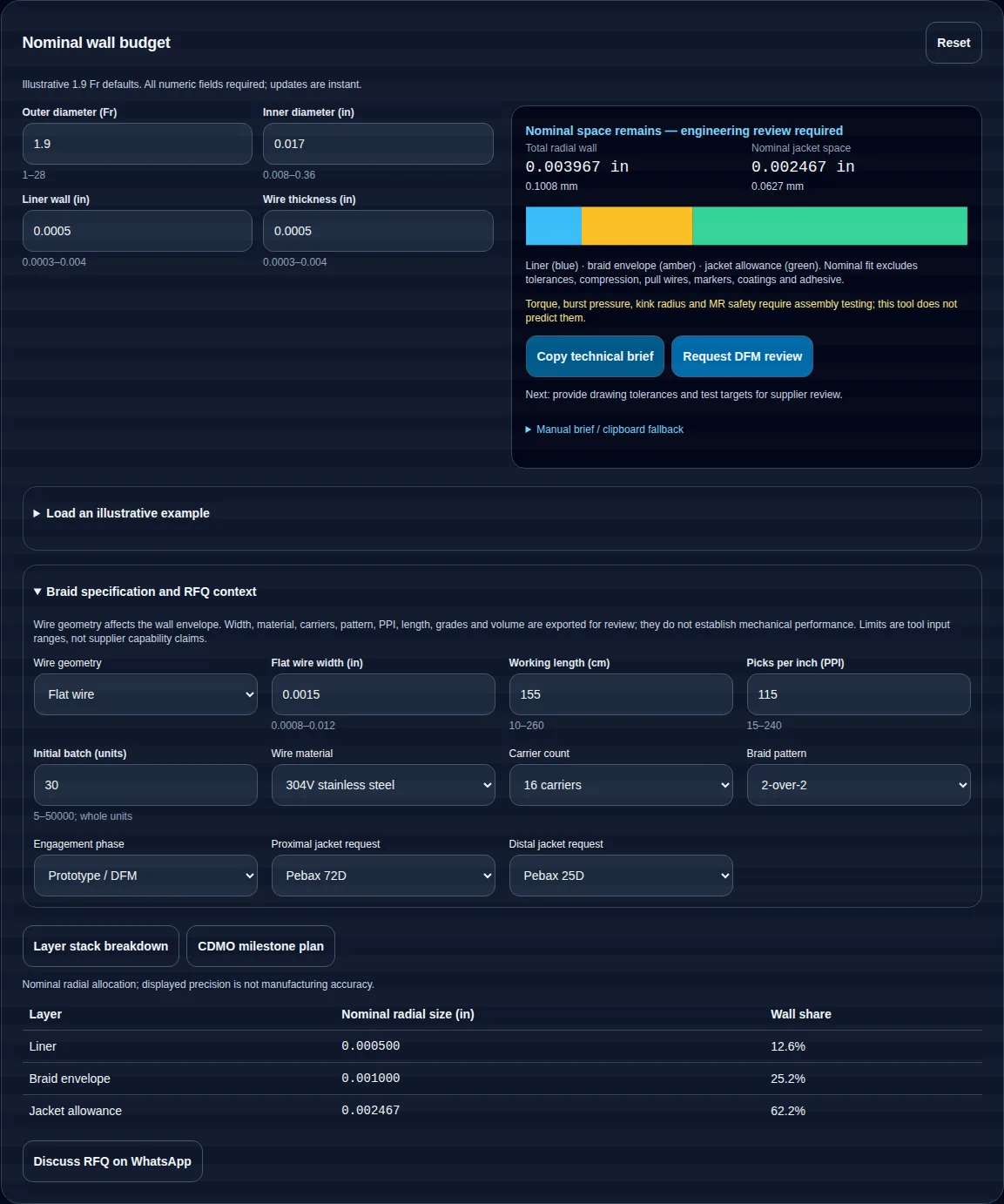
OD 0.6333 mm; radial wall 0.003967 in; jacket space 0.002467 in.
Positive nominal budget. Check tolerance extremes, sections and device-specific testing.
6 Fr, ID 0.071; liner 0.0008; wire 0.0009
OD 2.0000 mm; radial wall 0.003870 in; jacket space 0.001270 in.
Compare local markers and worst-case tolerances before relying on the thin-wall concept.
12 Fr, ID 0.145; liner 0.0015; wire 0.0020
OD 4.0000 mm; radial wall 0.006240 in; jacket space 0.000740 in.
Small-allowance flag triggers. Review thinner layers or larger OD with the supplier; it is not a universal rejection limit.
Actual software execution captured October 25, 2026: 1.9 Fr OD, 0.017 in ID, 0.0005 in liner and 0.0005 in wire thickness. Tool-only crop with site header hidden. This verifies reproducible arithmetic, not physical shaft performance, supplier capability or customer endorsement.
Boundary example: 14 Fr OD is about 4.667 mm, so an ID of 0.185 in (4.699 mm) cannot fit. The tool rejects ID ≥ OD and prevents export until inputs are corrected.
Sources, dates and evidence boundaries
Public source scopes checked October 25, 2026. FDA bench-report guidance is dated December 2019; FDA states QMSR took effect February 2, 2026. Catalogue descriptions are used for scope checking, not as a substitute for full licensed standards or regulatory review.
Catalogue scope: general requirements for sterile, single-use intravascular catheters.
Boundary: Public scope does not establish a universal jacket minimum or prove this shaft meets the standard. Use the full applicable standard for a test plan.
[S2] FDA — non-clinical bench performance test reporting (2019)
Explains documentation for bench protocols, summaries and reports in premarket submissions.
Boundary: Device-specific testing is required. This is not a source for fixed torque, kink or burst criteria, and it excludes computational modeling and sterilization validation.
[S3] FDA — Quality Management System Regulation (QMSR)
FDA states that QMSR became effective on February 2, 2026 and incorporates ISO 13485:2016 by reference.
Boundary: This framework does not prove any supplier is certified or that a specific process is qualified. Confirm applicability with the device sponsor.
The catalogue identifies wetting tension testing for polyethylene and polypropylene films.
Boundary: It does not directly set etched-PTFE adhesion acceptance. Agree a substrate-specific surface and bond verification method with the supplier.
Evidence not provided: supplier certificates, cleanroom records, production capability data, performance test reports and quotations. No ratings or price forecasts are inferred from those unknowns.
Questions for your engineering and sourcing team
Using the tool
What does this braided catheter shaft CDMO tool calculate?
It converts Fr to nominal OD and subtracts liner plus a two-wire crossover envelope from the radial wall budget. It prepares an RFQ brief. It does not predict functional performance or select a qualified CDMO.
Does a positive jacket allowance mean the shaft is manufacturable?
No. It only means the simplified nominal dimensions fit. Tolerances, wire orientation, reflow movement, additional features and process evidence can change the outcome. Request worst-case stack and cross-section review.
What is the basis of the 0.0008 in jacket flag?
It is an illustrative internal screening threshold to prioritize discussion, not a published universal limit or a manufacturing acceptance criterion. The CDMO must justify an appropriate allowance for the actual materials and process.
What if dimensions are unknown or copying is unavailable?
Reset to an illustrative example to explore the method. For a real project, use Request DFM review and attach the drawing. If clipboard access fails, open the manual brief and select its text to copy.
Braid and process choices
When should we compare flat and round wire?
Compare both when lumen and wall constraints are important. Flat-wire thickness and width are independent inputs; round wire uses its diameter. Match physical samples against the same requirements before assuming equal stiffness, durability or cost.
Why are braid angle and coverage not reported?
PPI conventions, number of ends, pattern and braid pitch diameter must be agreed with the supplier. An unverified angle or coverage formula would give false precision. Ask for optical braid measurements on representative coupons.
Is a selected wire material MRI safe?
No MR status is inferred here. Material selection alone cannot establish the behavior of the finished assembly, including markers, joints and other metal parts. Request assembly-specific evidence and labeling review.
Does changing PPI guarantee better torque or kink behavior?
No. PPI is recorded as a requested process setting. Mechanical response also depends on wire, pattern, bond state, polymer, length and loading conditions; compare prototypes under an agreed protocol.
Sourcing, cost and transfer
What should a braided catheter shaft CDMO quotation include?
Request separate development/tooling, material, build, metrology, destructive-test and qualification costs. Specify drawing revision, quantity, acceptance criteria and required documentation so quotes can be compared on the same scope.
What are the minimum order quantity and delivery time?
They are not verified on this page. Ask the supplier to confirm stock, tooling, build quantity, testing capacity, release criteria and schedule dependencies in a written quotation.
Are cleanroom classification and ISO certification confirmed here?
No supplier certificate or facility report is presented. Request current certificate scope, site details, relevant controlled-environment records and process qualification evidence before making a sourcing decision.
Who owns tooling and development records?
Define ownership, access, maintenance and transfer rights in the development and quality agreements. An NDA alone does not establish ownership of tooling, recipes or background intellectual property.
Evidence and validation
Does ISO 10555-1 establish a universal braid or jacket design?
The public catalogue describes general requirements for sterile, single-use intravascular catheters. It does not establish the nominal wall assumptions in this tool. Review the full applicable standard and intended use with the device sponsor.
Can ASTM F2606 be cited as the catheter kink test?
Its catalogue scope is stent and stent-system three-point bending. Do not present it as a catheter-shaft kink standard. Agree and justify a device-specific kink method, especially if adapting another method.
Does a good prototype prove production readiness?
No. Review representative lots, measurement capability, process controls, yield, traceability and changes before release. Agree capability targets from product risk and data; a single generic Cpk threshold is not proof of readiness.
Does changing CDMO determine the regulatory submission pathway?
This page cannot determine that. The device sponsor must assess the specific design, process, supplier and market changes, document the evaluation and obtain appropriate regulatory review before implementation.
Turn the geometry screen into a reviewable RFQ
Copy the tool brief and attach a controlled drawing. Include OD/ID tolerances, local features, length and zones, material preferences, intended use, test targets, quantity, development stage and requested documentation. Request confirmation of scope, open risks, NRE, unit price and schedule dependencies.
If email is unavailable, use the tool’s selectable brief and your existing procurement channel. Agree confidentiality and transfer terms before sending proprietary drawings.